
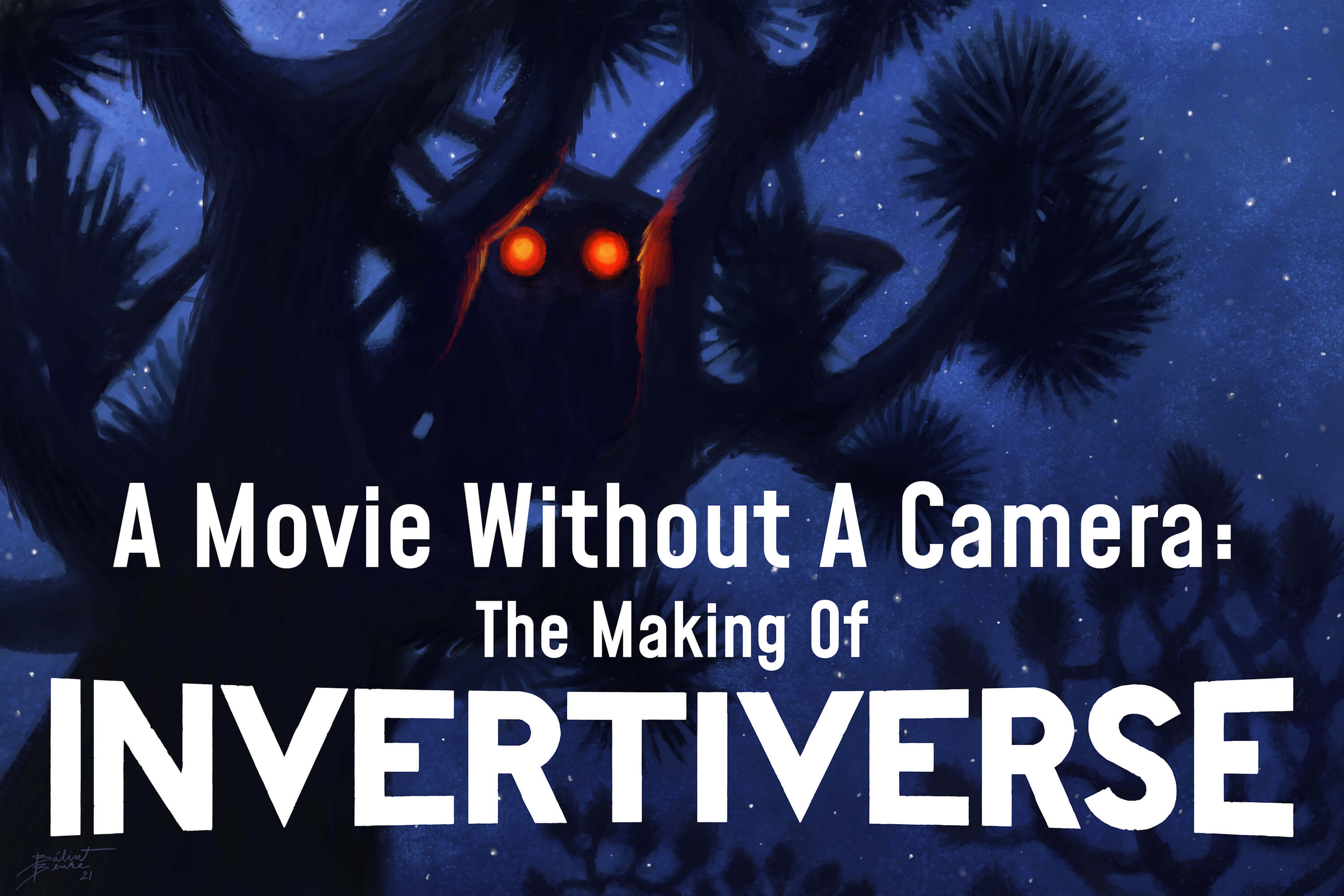
Author Derrick Davis details the long history of his debut science fiction novel ‘Invertiverse.’
Featured in the upcoming book: ‘The Art & Making of Invertiverse’
SCIENCE FICTION INSPIRATION
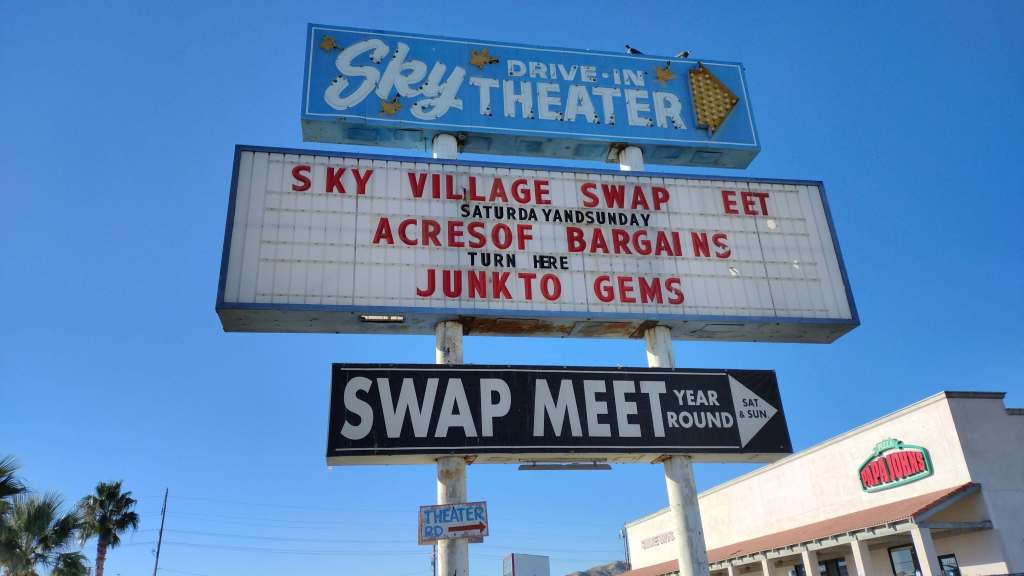
Back in 1993, I was about six years old playing at Yucca Valley, California’s community park with the once-operational Sky Drive-In nearby. From my viewpoint, a movie was silently playing on the screen, since the speakers were too far away to hear anything. There were dinosaurs running against the night’s starry sky. At my age I was already interested in dinosaurs, so I was naturally attracted to the film’s imagery. I asked my parents, “What movie is that?” They told me it was called ‘Jurassic Park.’ However, they also warned it was probably too scary to actually watch it.
Several days later, I heard kids talking about the movie at school after they had apparently seen it. It made me a little jealous. So, naturally, I bugged my parents until they finally caved in and took me to the Drive-In. They were right: I was scared. Curiously, as several days passed, I kept thinking about it until I bugged them to see it again. I was still scared, but somehow, I liked the adrenaline it created and realized it was a fun experience. I fell in love with ‘Jurassic Park’ after that, and it has been my favorite film and story ever since.
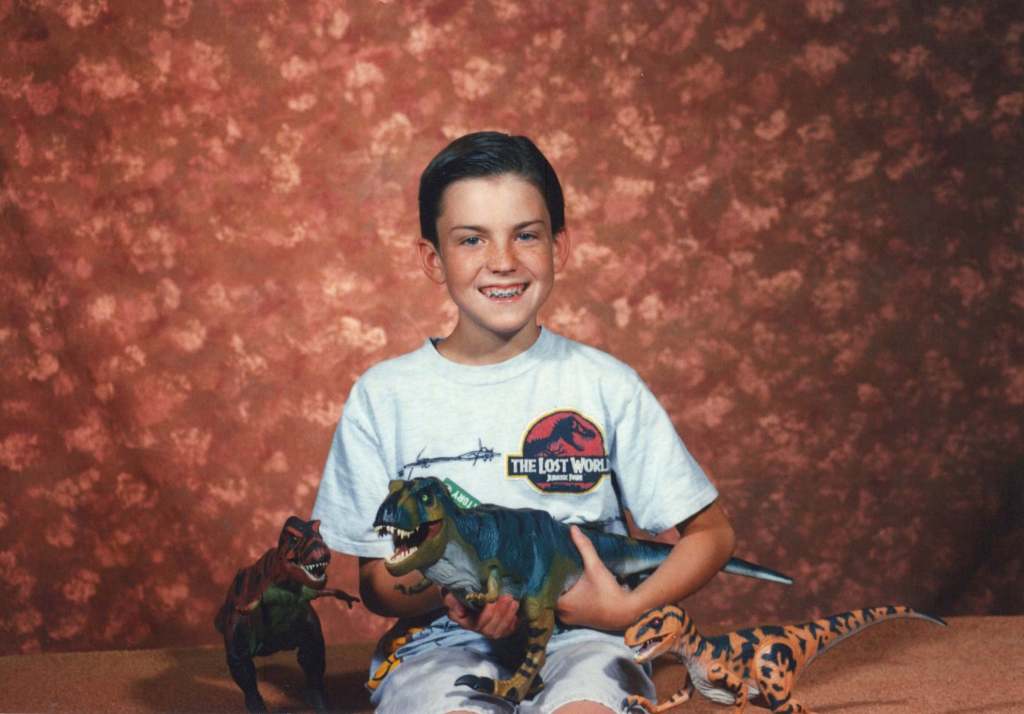
‘Jurassic Park’ became a sort of “gateway drug” to my love of many other science fiction stories and movies in general. What makes science fiction so compelling to me is that it’s often extraordinary but can often feel plausible enough to actually happen. The science of cloning dinosaurs described in ‘Jurassic Park,’ for example, feels so fully realized that it has been an inspiration for real scientists to this day. However, that is a little disturbing given the warnings of what goes wrong in that story. But that’s also my attraction: the cautionary tales of what science fiction stories usually entail.

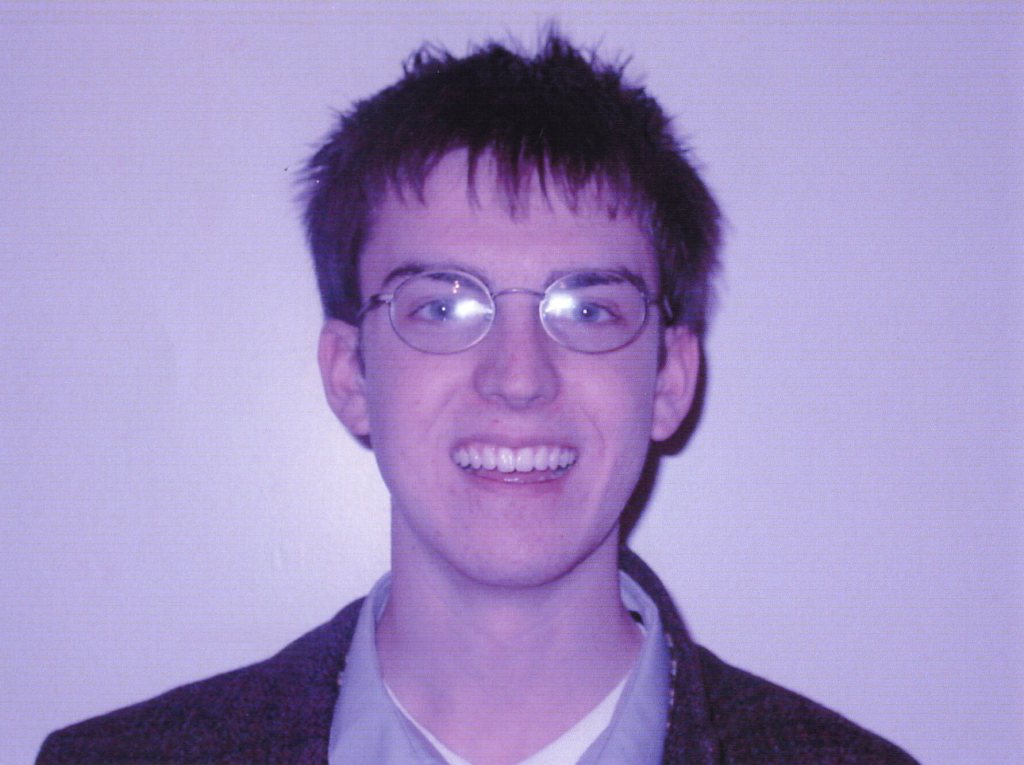
For many years, I wanted to be a filmmaker. I was interested in writing and directing, while also taking on acting roles in local theater & school productions to have a better understanding of characters. I was even an “Official Observer” for the Bryan Cranston film ‘Last Chance’ that was filmed in Yucca Valley, and its surrounding areas, right before his ‘Malcolm In The Middle’ and ‘Breaking Bad’ fame.

Since third grade, I had also written numerous lengthy stories, with science fiction remaining my preferred genre. A big one was created during junior high: a novella-length time travel adventure where a paleontologist explores different eras of prehistory. Titled ‘Time Dome,’ it was never officially published—although it was once uploaded to some websites. Still, it was a great exercise and included a sequence that would eventually become repurposed (involving hiding behind a shower curtain in a small bathroom).
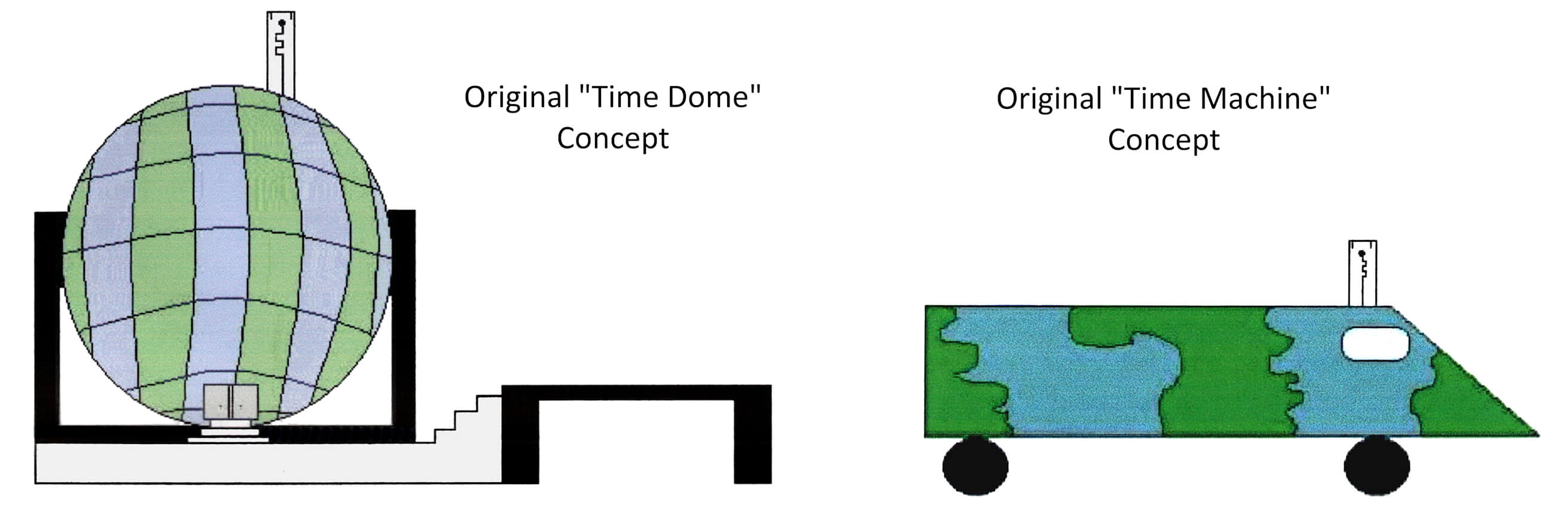
While I didn’t end up seriously pursuing filmmaking like I had originally intended, I still had many ideas for other stories that would just never go away… leading up to my debut novel ‘Invertiverse.’

THE NOVEL’S CREATION TIMELINE
My articles and shorthand writing are usually done in a quicker timeframe with largely non-fiction topics. But when writing a fictional novel, a whole world must be created (or in this case several) that features characters with their own personalities and histories. Then you have to wrap it all around a plot that drives at a good pace and makes sense.
In 2014, I began outlining the story, which was originally titled ‘Retcon Ride.’ These weren’t simple outlines; they included detailed descriptions and often early versions of dialogue. In a way it was an “abridged draft,” nearly novel length. The story was originally going to be a trilogy of novels that depicted a madcap adventure across the multiverse, crammed with as many crazy ideas that I could imagine. However, before writing a real draft, I decided to revise the outlines with a more serious tone and greater emotional stakes for the protagonists. This revision in tone and structure included a title change to ‘Invertiverse.’
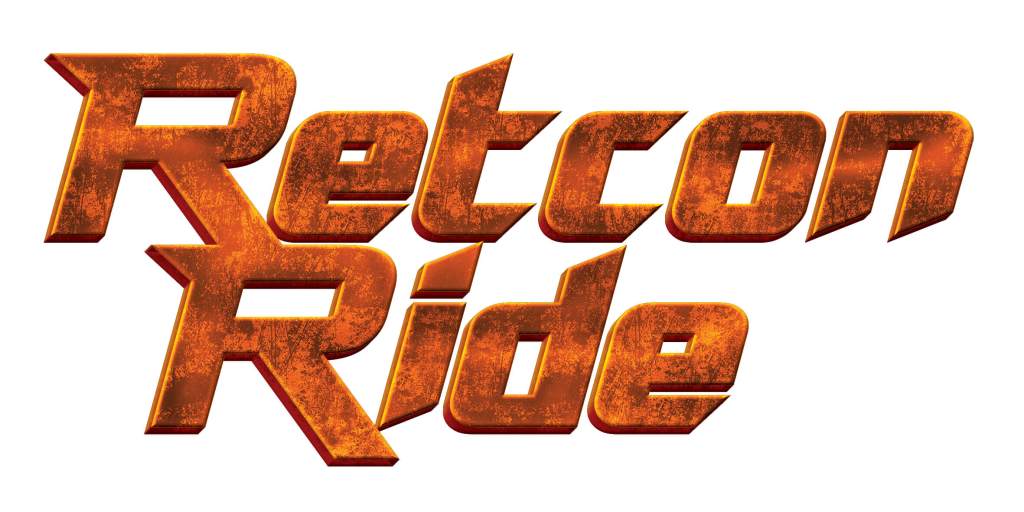

The first draft of the trilogy’s “Part One” was completed in early 2016. But after some reflection, I realized the story didn’t quite work being dragged out across three novels. So, within the same year, I rewrote the entire thing to make it a single, complete book. It was an extremely quick turnaround to suddenly condense the story, but since I already had so much to work with, it was just a matter of whittling it down to its vital essence. There’s a lot of fun stuff that I miss from that originally intended trilogy, but if one compared it to the final draft of the novel, it would be two completely different stories.
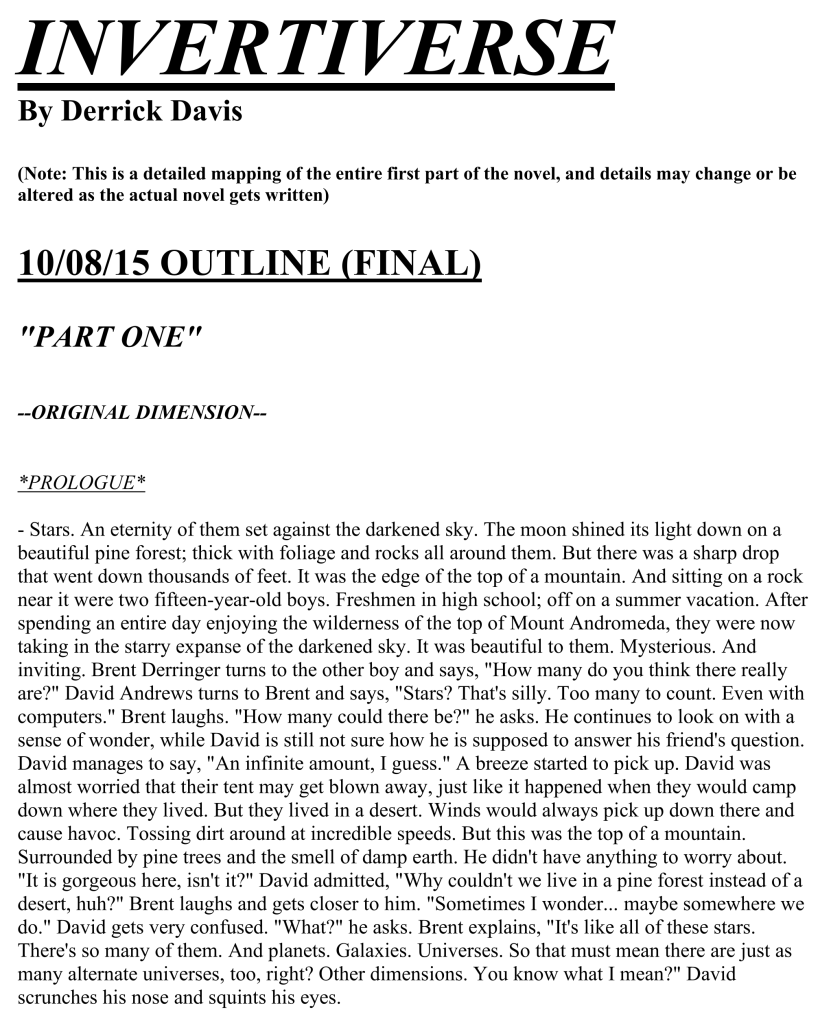
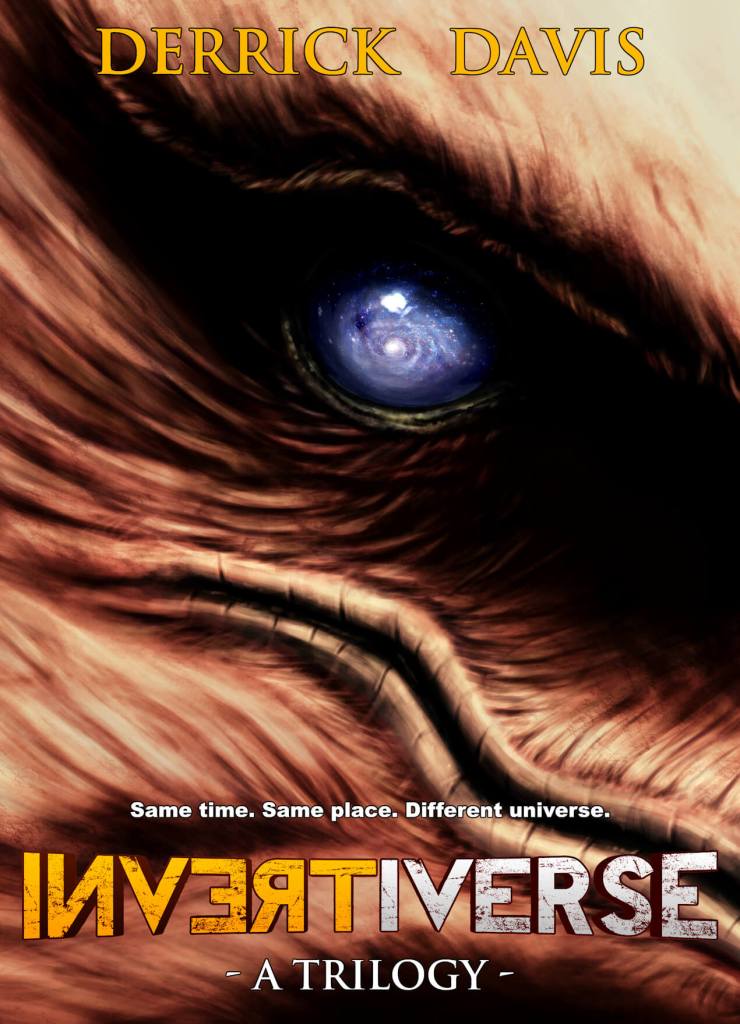
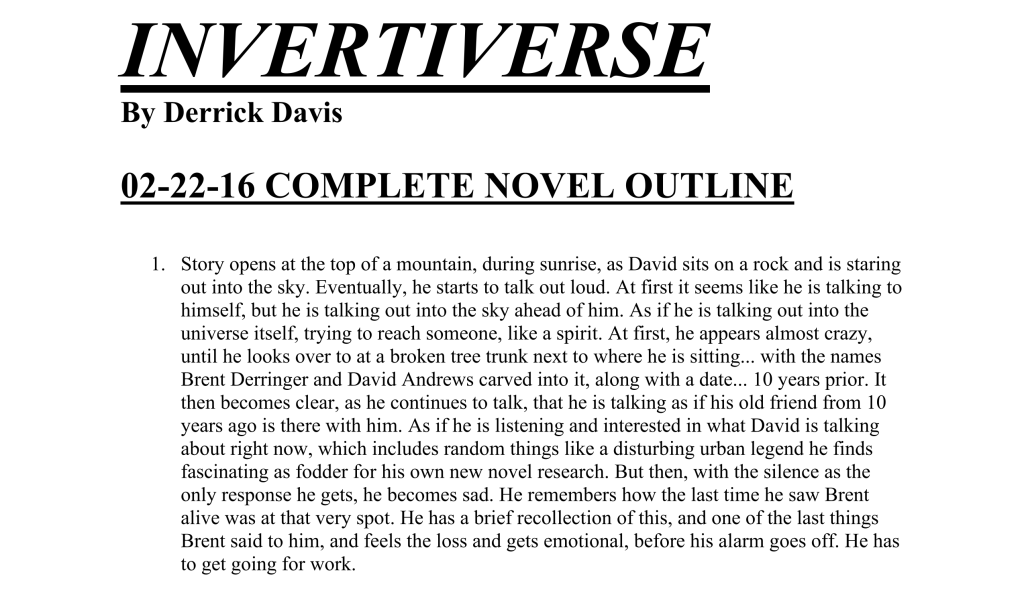
First drafts are generally never great, and this was no exception. However, my retail job got in the way for a while, making it hard to have time dedicated to figure out what needed improvement. A lot of new notes and outlines were written until an updated draft materialized in 2019. But it still wasn’t quite there.
Then in 2020, the pandemic happened. Suddenly I had a lot more time on my hands and was able to really focus on the story, with some input from friends. For several months during this time, I was also house-sitting for a friend. They had a pool, and I hadn’t gone swimming in years. Being suddenly back in the water again inspired some aquatic scenes that likely wouldn’t have existed otherwise.
Many drafts were finally cranking out, especially in the following years where I would return to that house and embrace the isolation. The story continued to change in many ways, from how the characters were portrayed to altered plot points. During this time, I also attempted to get an agent or a publisher, but it never happened. Writing is a highly competitive field. In the end I knew I had to publish it myself.


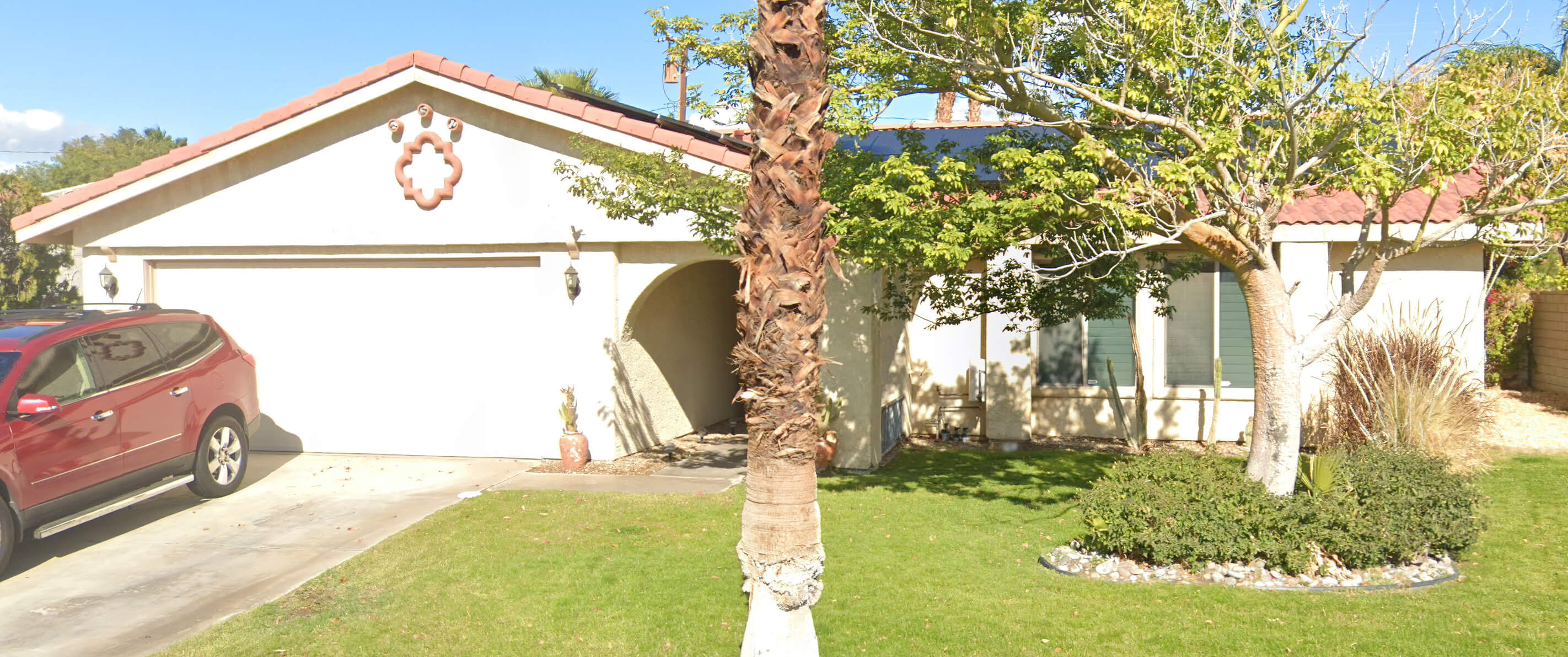

Finally in 2024, I felt like the novel was as good as I could possibly write it on my own. I got the help of an editor through the popular Fiverr service, then friends who recommended additional edits. By the end of the year, I produced the final draft and went through the complex steps to self-publication.
THE LONELY WRITING PROCESS
My favorite part of the writing process is when everything seems to be set in stone, but then you randomly come up with an idea that totally changes things. Maybe it’s an exciting plot detail, or a unique character trait, a change in the setting, or some other idea that never occurred before. It’s a goosebump-inducing realization. I get excited to implement such ideas, convinced they will reshape anything from a single chapter to the entire narrative. It doesn’t always work out that way, and often those ideas get removed as soon as they are put in place. But if I revisit the new ideas weeks later and feel that same tingling excitement, they’re a keeper.
One of the earliest ideas that totally reshaped the story was implementing a dramatic backstory. The novel’s synopsis mentions the death of the protagonist’s closest companion, derailing his life. This also happened to me: many years ago, someone who I was once in love with had a sudden, unexpected death before I ever got to express my feelings to them. The story would portray my lingering emotions through the protagonist’s fictional circumstances. While putting an author’s history into a character isn’t some new concept, it was a way for me to make the story a personal, therapeutic experience to strengthen the narrative. As I worked it into the story’s multiverse adventure, the real-life emotions not only became part of the central themes but also the “hook” to reel people in: the chance that the protagonist could “finally confess his true feelings to the same person he had lost.”
My least favorite part of the writing process is the endless isolation you must force yourself to be in. I sacrificed a lot of time that could have been spent with other people or focusing on myself. Writing is a lonely passion.
DESERT INSPIRATIONS
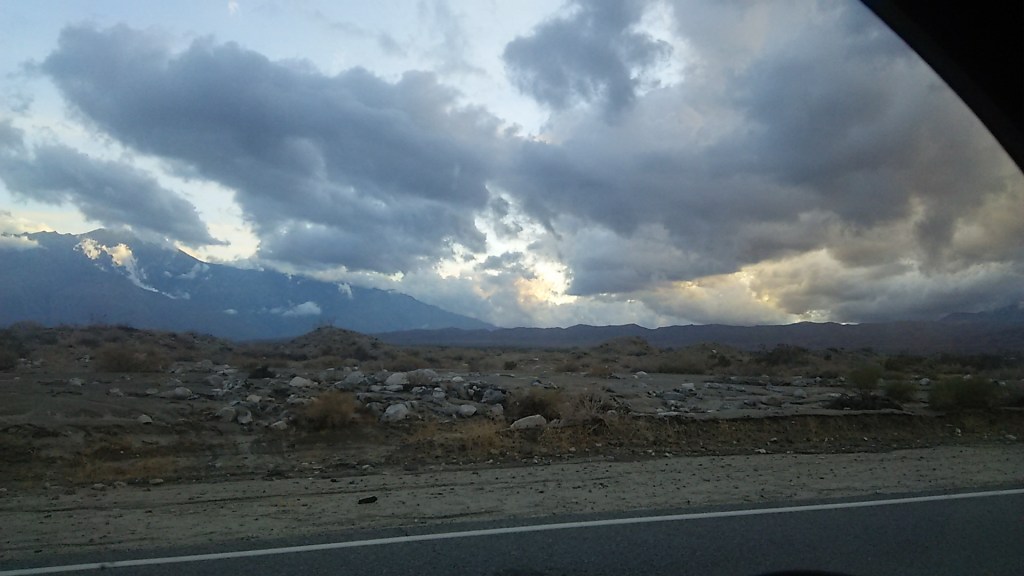
The novel is set in a fictional town that is very much a combination of Southern California’s desert region that includes Yucca Valley, Joshua Tree, and Palm Springs. It has Yucca Valley’s quaint, rural feel mixed with Joshua Tree’s tourist vibes and Palm Springs’ aerial tramway to Mount San Jacinto. All these towns have desert-based plant names, so I continued the trend by naming it Juniper Valley.
As the saying goes: write what you know. I’ve lived in Yucca Valley most of my life, hiked around Joshua Tree National Park & the Morongo Preserve for years, and worked in Palm Springs for a decade while enjoying its tram. So, I know the area pretty well. The desert landscapes, and nature in general, have always been inspirational to me. I wanted to express my appreciation of the desert landscape; at least in the first third of the story.

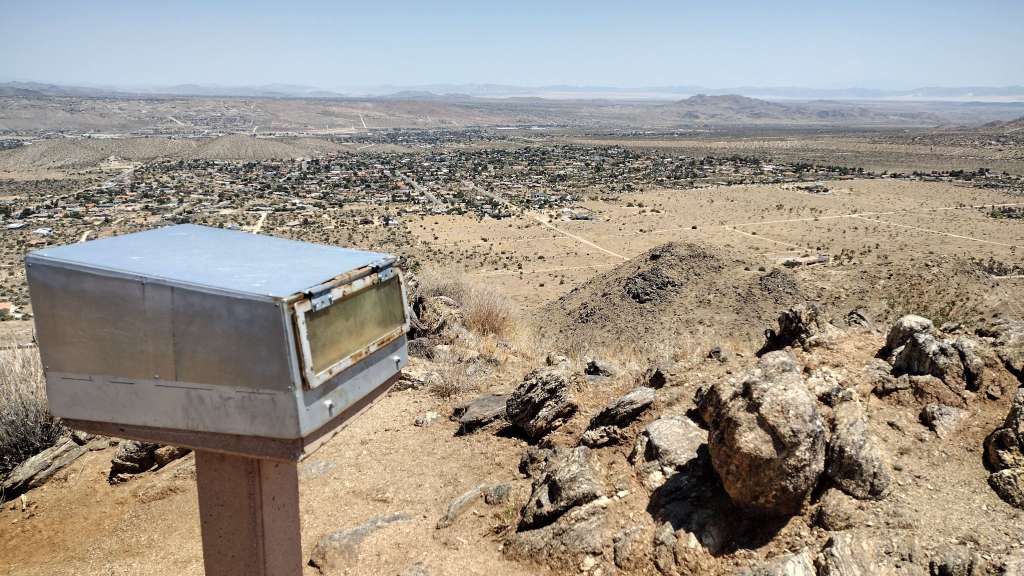


Of course, this is still a fictional town with its own unique history, such as disturbing urban legends that are thankfully not from our reality. The story also features Joshua trees in creepy and eventually terrifying ways that I am surprised have never been used before (to my knowledge). Let’s just say: you may never look at a Joshua tree the same way again.
THE WORLD-BUILDING PROCESS
The alternate worlds of ‘Invertiverse’ were inspired by many things, but several ideas came from my 15 years in retail. There is a universe that the story spends a lot of time in that reflects how ridiculous the retail world can be, and how consumerism can get out of hand if people are reckless enough with it. I privately call this place the ‘Reckless Universe.’ Businesses are as reckless as the customers allow them to be in this universe, which all feels like a good thing on the surface until you think about the implications. It’s all done with amusement at first, until the darker side of it all is revealed.
Many ideas for other alternate worlds came and went through all the outlines and drafts. The goal was always to have places that were extremely cool, weird, scary, or visually amazing. However, it all hinged on how each place would take the story forward, leading to the final destination: the invertiverse.
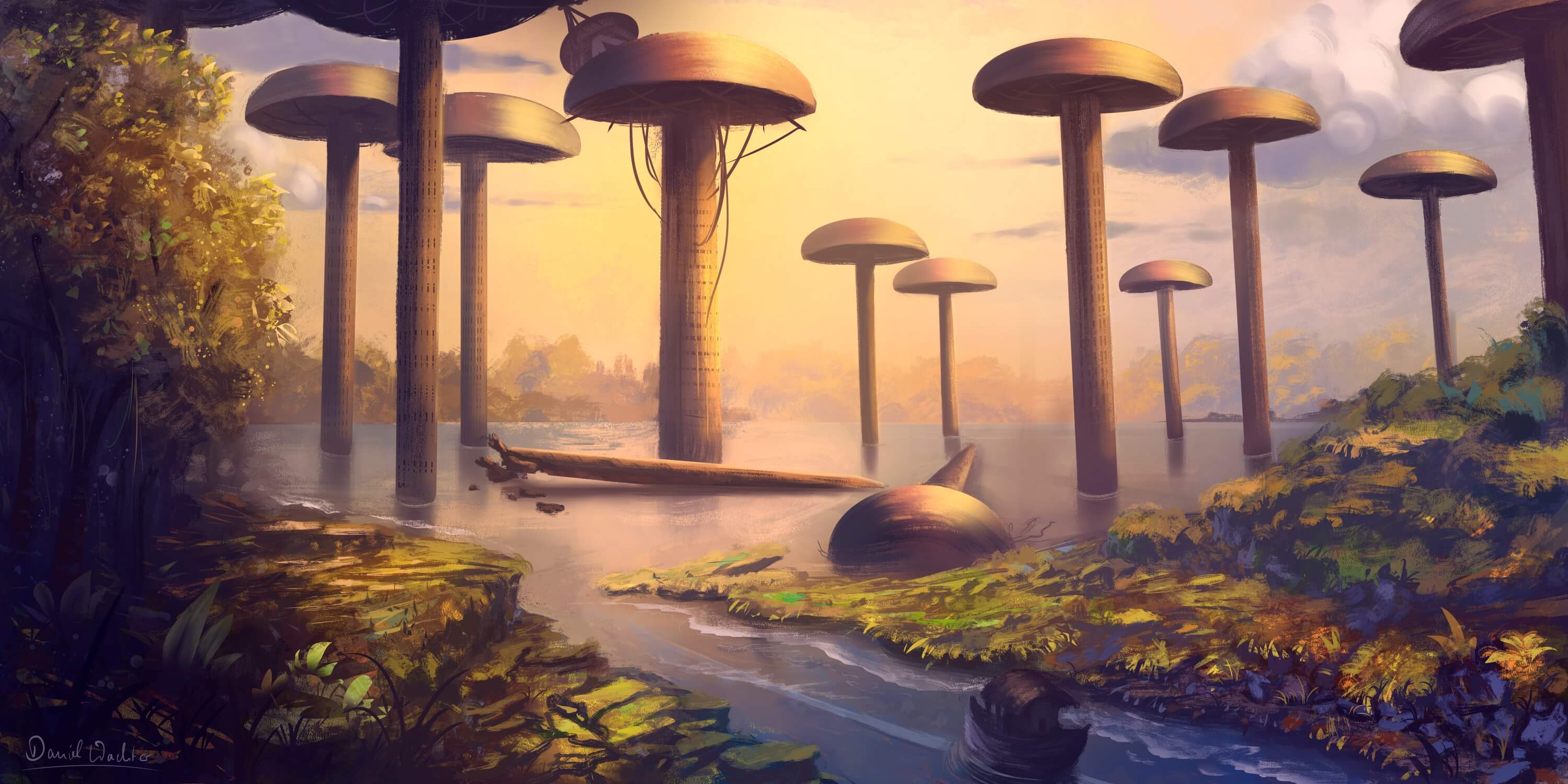
The novel’s titular universe was always intended to be a mysterious, alluring, and dangerous place—inspired by abandoned locations from reality and fiction. Such inspirations included movies like ‘Return To Oz’ and the computer games ‘Riven: The Sequel To Myst’ and ‘Trespasser’ (the digital sequel to ‘The Lost World: Jurassic Park’). It was also based on the dominant setting of a novel I had written in high school, titled ‘The Bermuda Triangle.’ The novel used the legendary location as a portal to another world. This story never went past the first draft, seen only by a few online, but it is proof again that some ideas will always come back if they are engaging enough.

AUTHOR INFLUENCES
Michael Crichton’s influence will be obvious to anyone who reads ‘Invertiverse.’ Not just from his original ‘Jurassic Park’ novel, but several others. His novel about quantum-based time travel to 13th century France, ‘Timeline,’ is another huge influence. The work of Stephen King (‘It,’ ‘The Mist,’ ‘The Shining’), Douglas Preston & Lincoln Child (‘The Relic’), and David Mitchell (‘Cloud Atlas’) were also strong influences. Even some classic fantasy stories, like Frank L. Baum’s ‘The Wizard Of Oz’ and Michael Ende’s ‘The Neverending Story’ were influential (despite my novel being largely science fiction-based).
Several films were also clearly inspirational apart from ‘Jurassic Park.’ The ‘Back To The Future’ trilogy, the ‘Indiana Jones’ adventures, the ‘Alien’ franchise, and even several Quentin Tarantino films. A friend of mine revealed ‘Invertiverse’ also has a very ‘Amblin’ feel. He is referring to ‘Amblin Entertainment’: the company Steven Spielberg created that pumped out several classic films during the 1980s and 1990s like ‘Poltergeist,’ ‘Gremlins,’ ‘The Goonies,’ ‘Twister,’ ‘The Mask Of Zorro,’ ‘A.I.: Artificial Intelligence,’ and a lot more. This sort of “fun, dark, adventure” vibe, missing from most recent films, is something I have always loved. I guess it all indirectly inspired ‘Invertiverse.’
WHAT READERS SHOULD TAKE AWAY
I really hope readers are entertained, first and foremost. The novel is designed to be a “frantic journey across the multiverse,” feeling at times like a thrill ride through various landscapes and creature encounters. However, the story is also seen through the eyes of two regular people with real, dark problems that I am sure readers could relate to or sympathize with. The protagonists are forced to confront their issues while dealing with the dangerous adventure, leading to a much more introspective story than perhaps readers are expecting.
Life can often feel out of control and very chaotic. It’s easy to give in to anxiety, depression, and loss (which everyone eventually experiences). Despite this, the story of ‘Invertiverse’ is meant to remind readers that our choices shape our own stories. While external forces clearly influence us, we make the choice to allow any darkness to consume us. We are our own greatest villain, and that is something worth remembering; even in what appears to be a fun adventure story.
FAVORITE MEMORIES
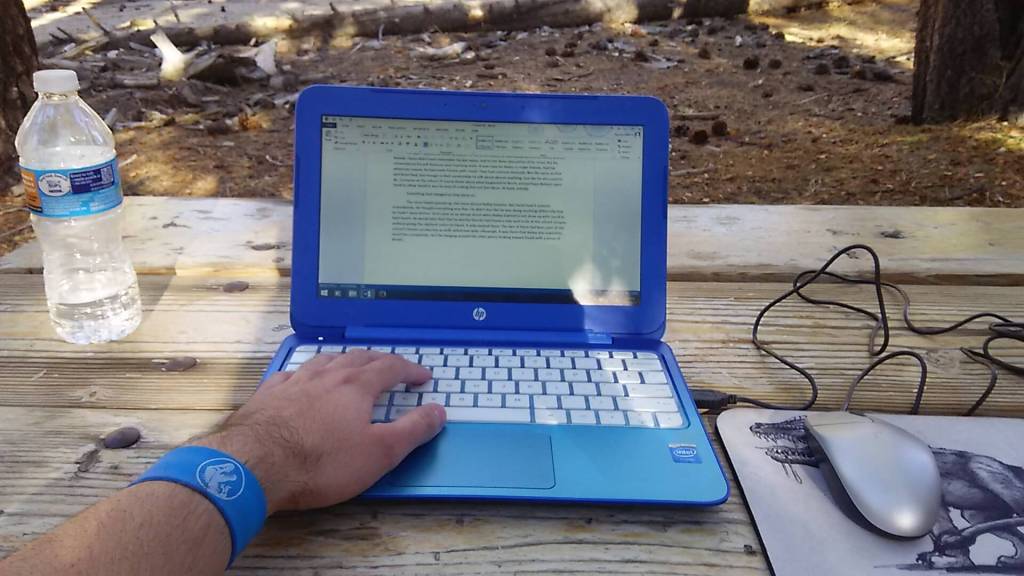
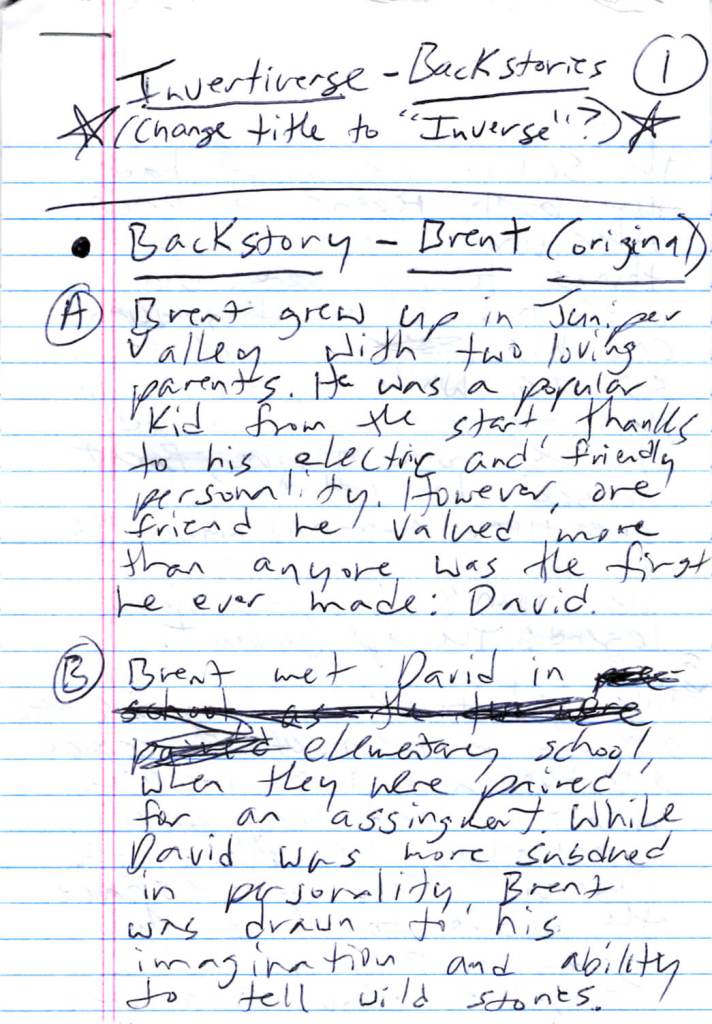
Given that it took me about a decade to write ‘Invertiverse,’ there are tons of memories associated with it. But to distill the more personal stuff out of my recollections here, I will say that the locations where the book was written are some of my favorite memories. While a massive portion was simply written in my bedroom, I often took my laptop or notebook with me to more inspirational settings.
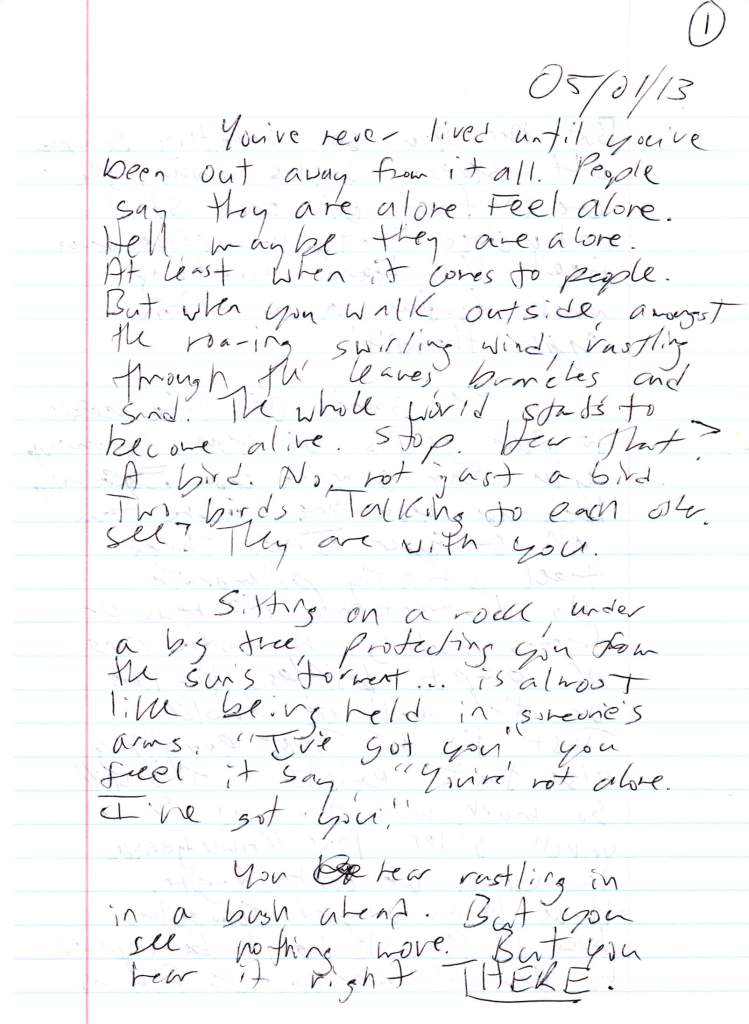
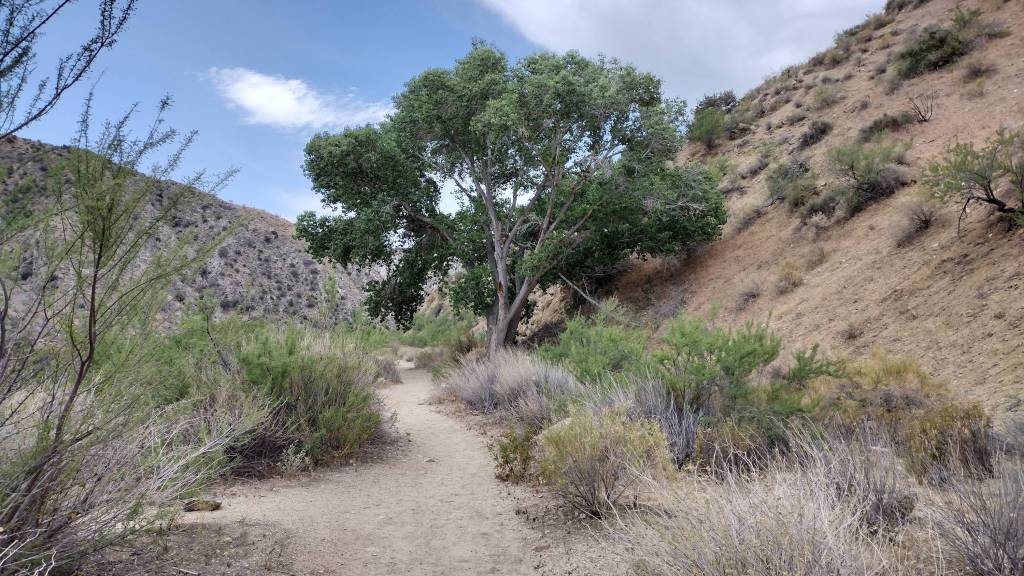


An early frequent place I wrote the novel at was the Frontier Café in Yucca Valley, (which went through several ownership and name changes over those years). It was nice to just throw on my headphones, listen to some film scores or ambient sounds, and allow myself to be in my own world while still feeling like I was part of society. Sometimes I’d seek isolation in places like the Morongo Preserve, Joshua Tree National Park, and even the top of Mount San Jacinto via the Palm Springs Aerial Tramway. It’s no accident that those places became vital inspirations as a result.



But probably my most fun memories are hastily scrambling to write notes while I was at work during my 9-year stint at the Palm Springs International Airport. I used to work in the gift shops there, and every summer would be incredibly slow. During this long downtime, I would often be lost in my own thoughts while cleaning this or rearranging that. I would often get an idea and have to race to find a notepad to jot it down. Even during my long drives from Yucca Valley to Palm Springs for work, I would suddenly get ideas and try to record a voice memo while attempting not to drive off the road. Thankfully, I never caused any accidents.


THE ILLUSTRATIONS
I did a few things for this novel that were probably bizarre, especially for a first-time author. I blame my naivety, but I truly felt that I was being clever at the time.
First, I had about 50 illustrations created by artists for the book’s print versions while I was writing it. In fact, some were created during the initial outline stage. Over the years, about a dozen illustrators worked on ‘Invertiverse.’ From college students to industry professionals, they are part of the novel’s visual aesthetics.
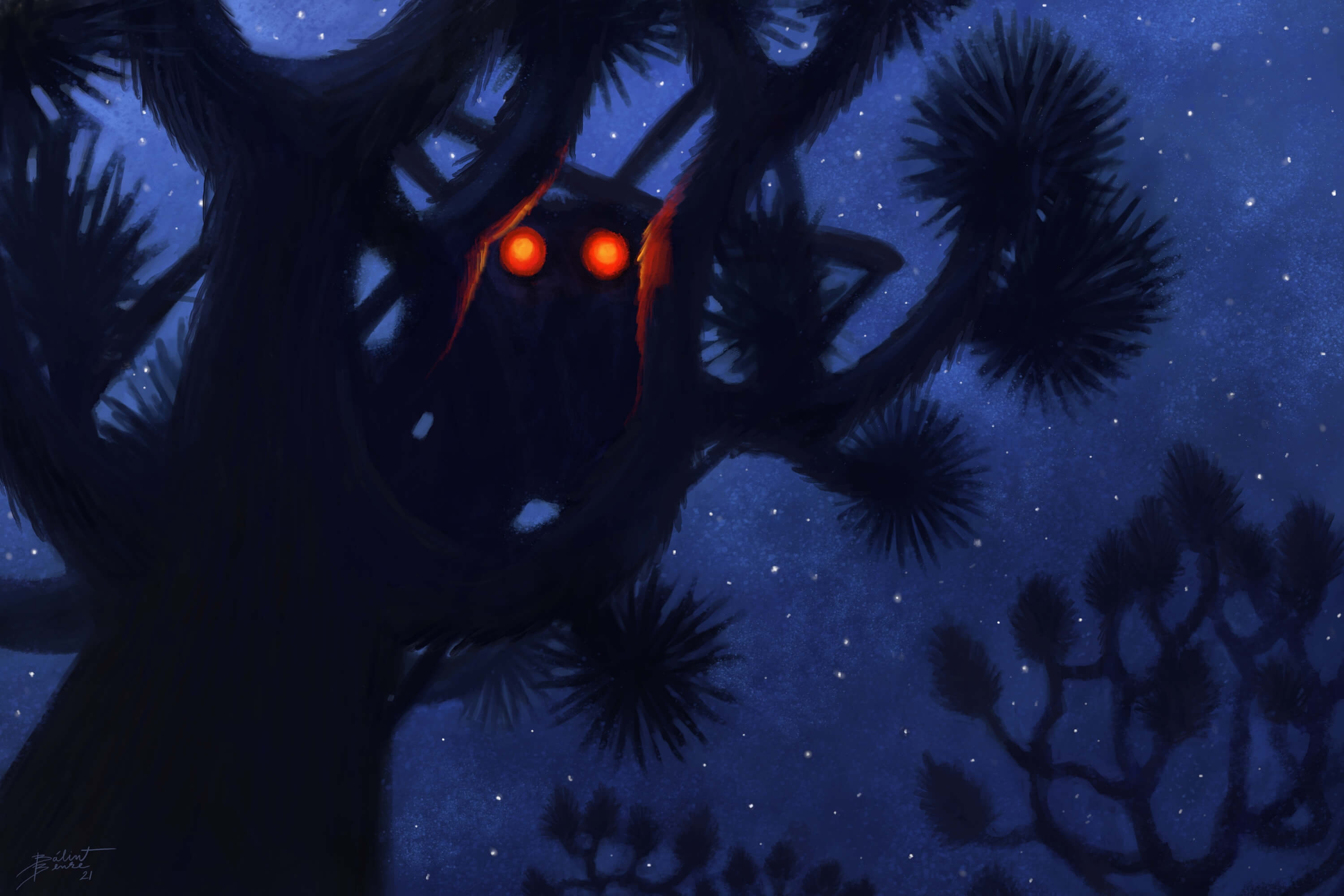
As one can imagine, things changed a lot during the writing process, rendering some illustrations obsolete. Some were redone by the same person, others were redone by someone else, and so on. I certainly would not recommend doing it this way, despite it being a unique creative process. It also made it needlessly costly. However, the final work speaks for itself.

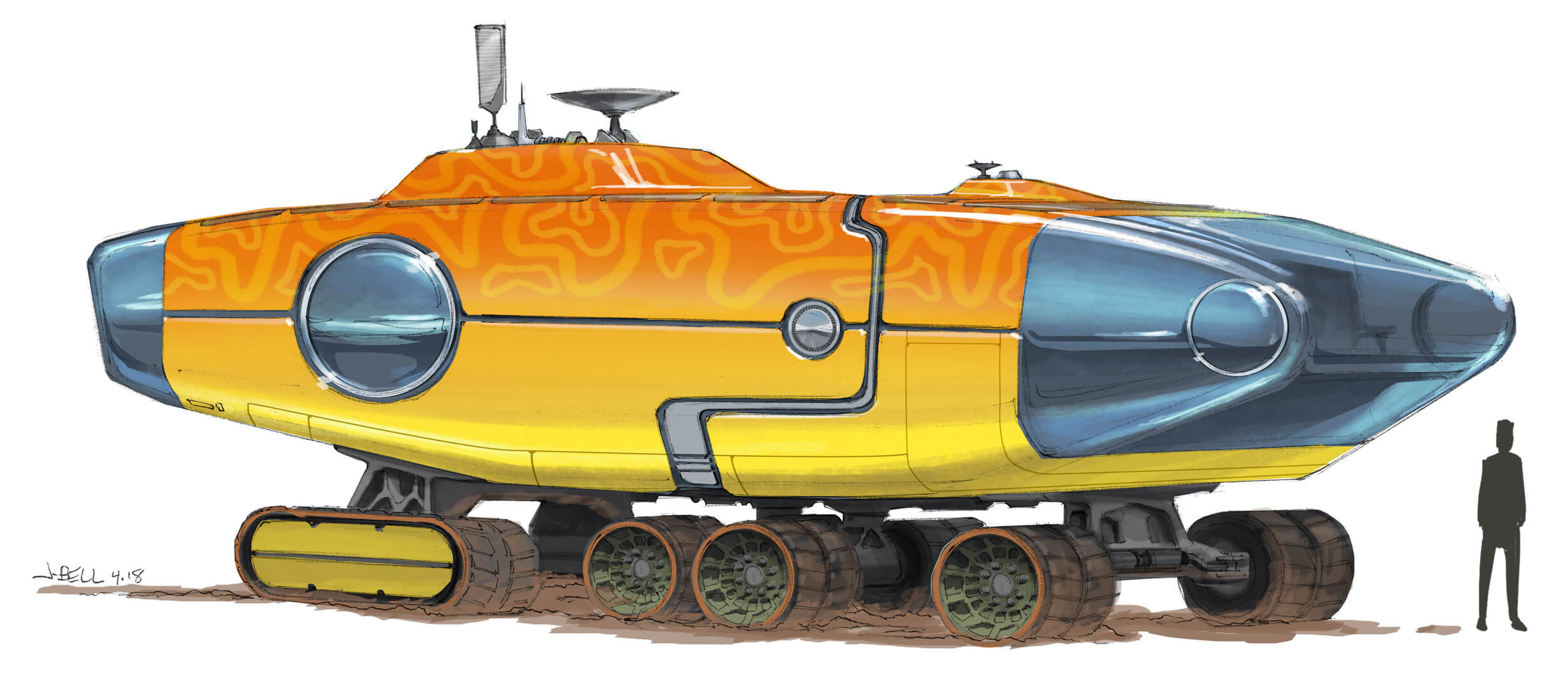
One of the incredible illustrations that is included depicts a vibrant vehicle designed by John Bell: The RocketLodge. He was the art director of ‘Jurassic Park’ that designed the look of the famous Jeeps and Ford Explorers. Having someone like him be part of my book was a dream come true.
THE SOUNDTRACK
‘Invertiverse’ also has an original music score. I love orchestral film scores, and ever since I was in high school, I had these ideas for themes that I would hum out whenever I went for a walk. But there was never a right time for me to learn how to write music once I started working in retail, so the themes just remained in my head.
However, as I started writing the novel, I had this crazy idea to hire composers that knew how to “play by ear.” I sent them recordings of me humming out each track I wanted, then had them co-composed and orchestrated into reality. In fact, a few pieces ended up being performed by real orchestras.

Some of the music is referenced in the story and heard by the characters; it is known as “diegetic” music. That’s one of my favorite qualities that makes the soundtrack an engaging companion piece to hear either alongside the novel, before reading it, or after reading it. Regardless, I think it’s unique for a book to have a full soundtrack album.

Anyone I tell these details to usually asks, “Why would you do all of this?” I’ll admit I was reckless and really envisioned this story as being cinematic. I believed having these extra features would flesh it out for readers beyond what they usually expected. While I would never do it this way again, I don’t regret it one bit. Thankfully, none of it has put me in debt, and I hope people enjoy it all as much as the story itself.
SEEING THE BOOK ON A SHELF
I am extremely thankful for the opportunity of having my book at some local stores. Seeing ‘Invertiverse’ on a shelf, with my name beneath its title, was the final step in completing my journey. It’s honestly a bit surreal. There will hopefully be additional locations in the future, but only time will tell.

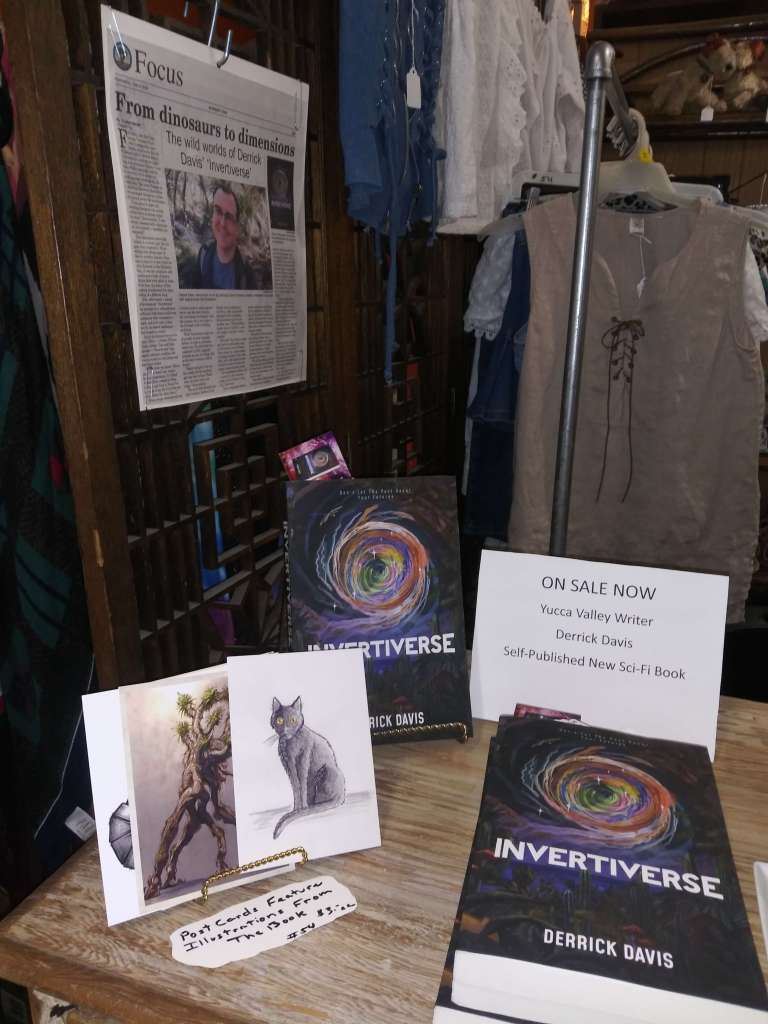
Part of being a self-published author is taking on all the responsibilities that are usually left to talented agents and publishers. Their jobs are not easy, as I can surely tell you now. A few words of advice to any upcoming self-published writers: research a lot of articles and watch a lot of YouTube videos about the process in advance. Don’t just put your book on Amazon unless that’s the only place you want it to end up (hint: use the IngramSpark service).
THE BOOK FESTIVAL
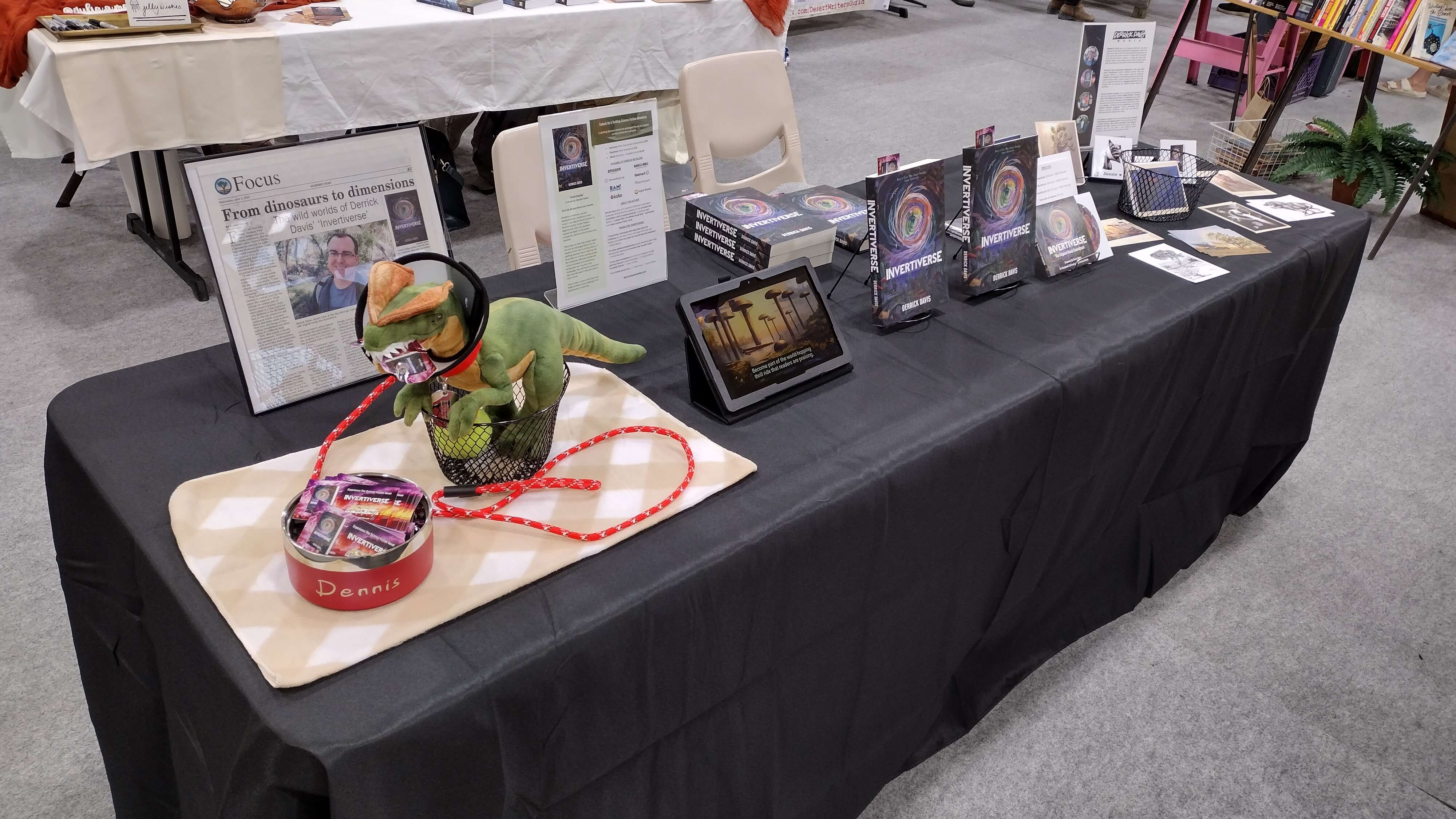
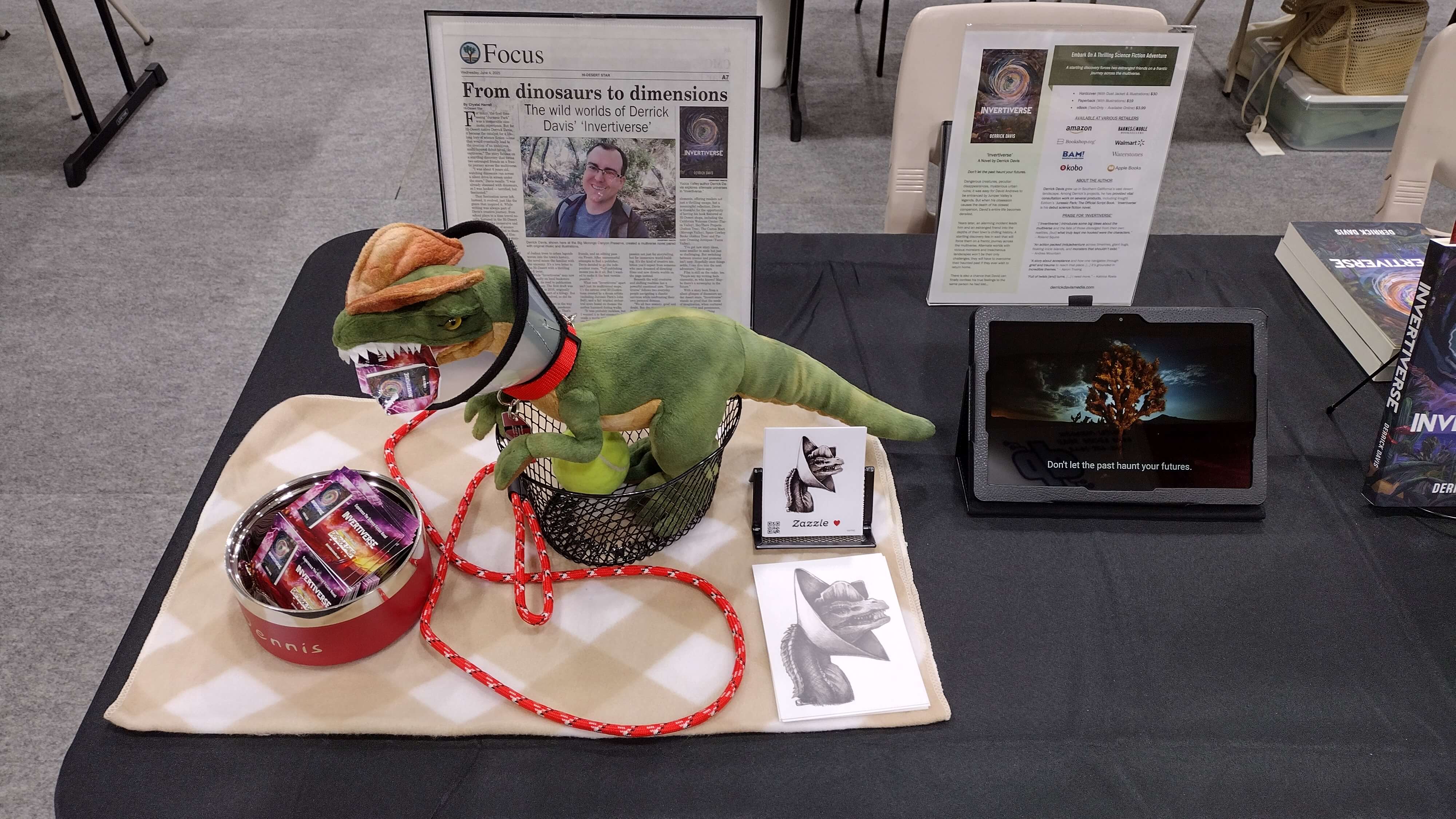
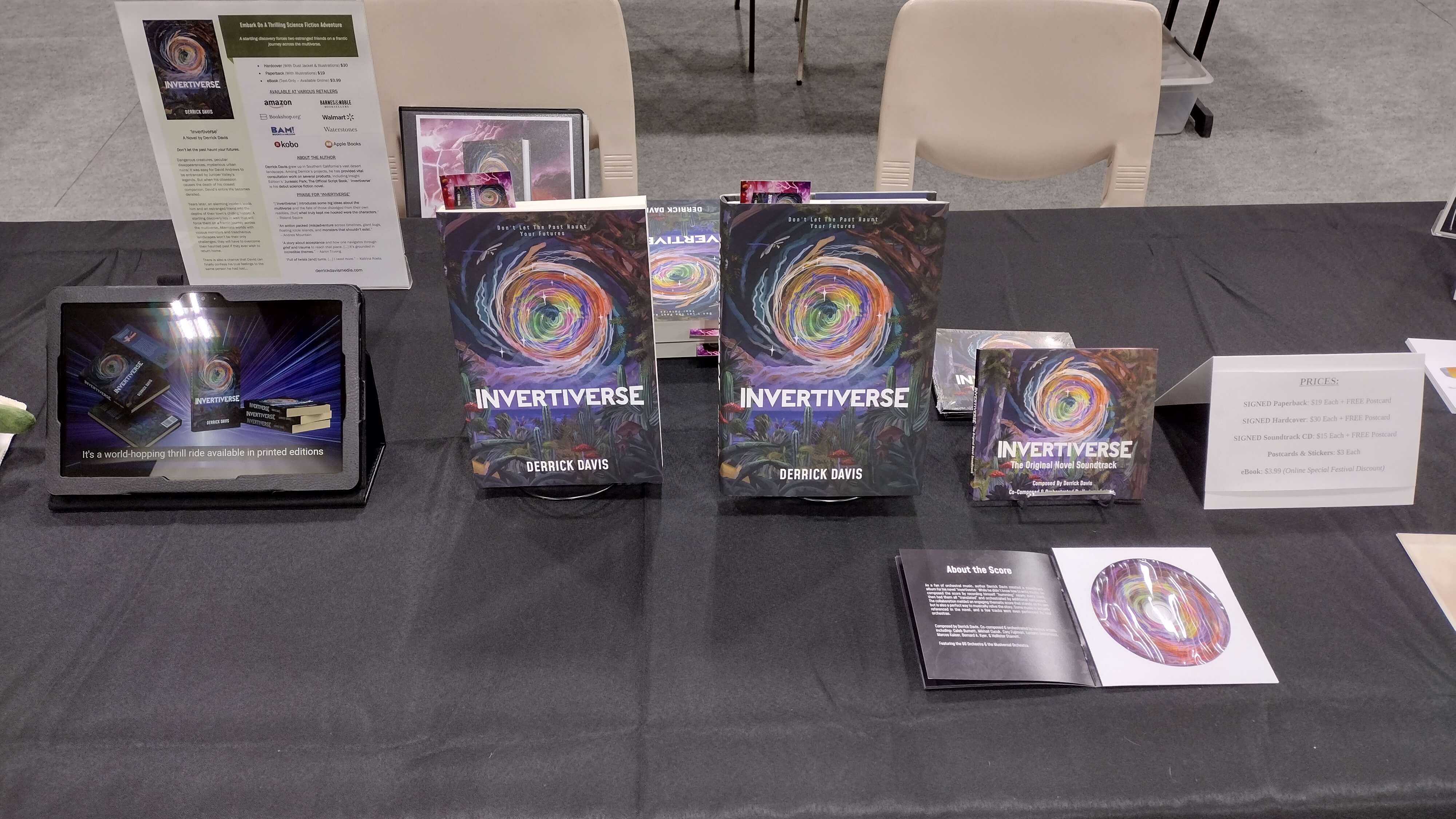


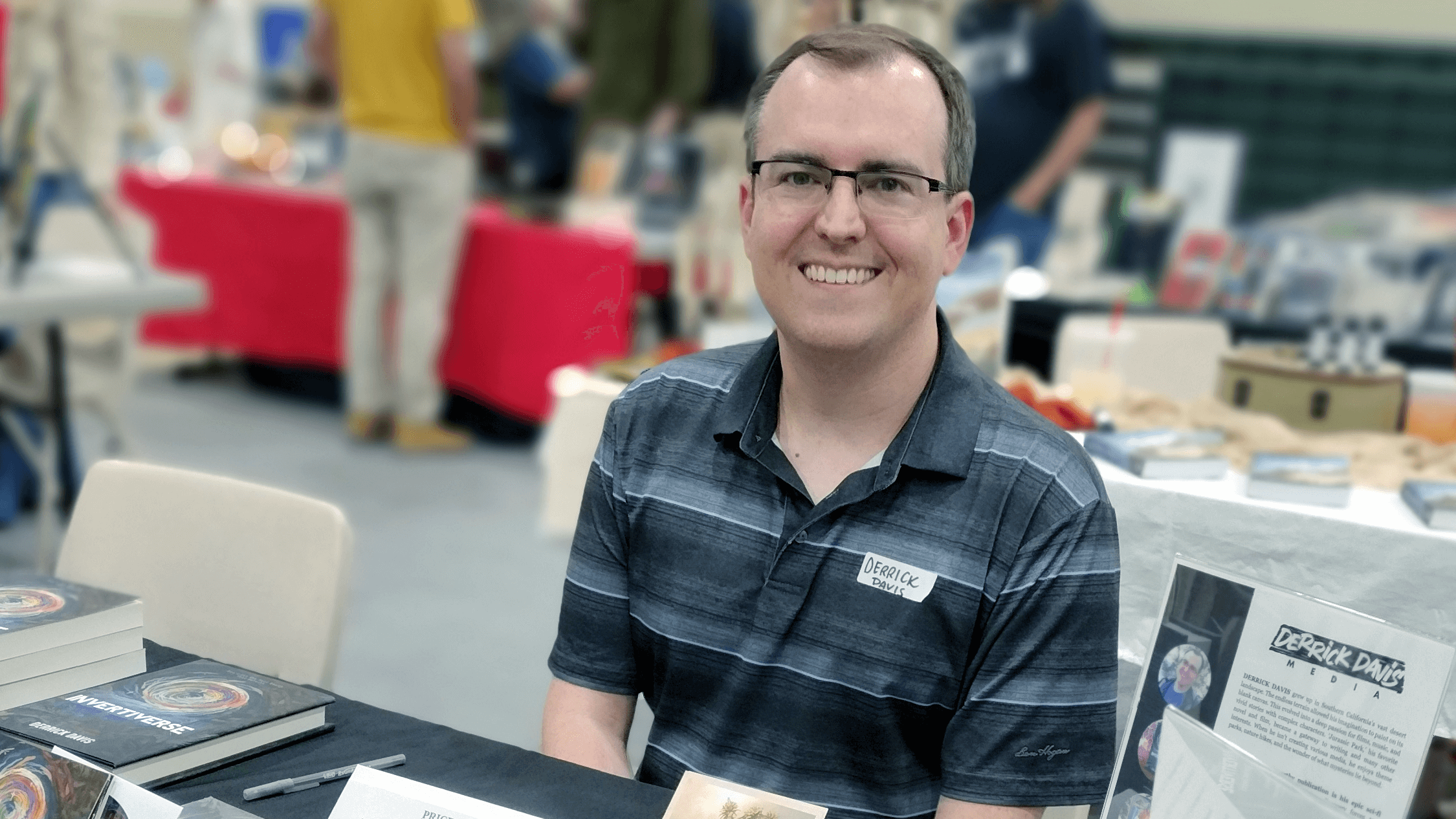


Images from the 29 Palms Book Festival, including Derrick’s table to sell & promote ‘Invertiverse.’
In November 2025, I was part of the Twentynine Palms Book Festival promoting ‘Invertiverse‘ and selling signed copies—all of which sold out. Considering it was the first time I had ever been part of a book festival, I was kind of shocked that happened. Postcards with some of the novel’s illustrations, stickers, and the soundtrack CD were also available. “Dennis,” a dog-sized pet dinosaur character from the novel, was also there—offering free business cards from his pet bowl. On the second night, I gave a special reading from my novel’s prologue during the ‘Voices Of The Desert’ event. The entire festival included a great community of authors & readers, and it was wonderful getting to know everyone. I’m definitely excited to attend future book festivals to promote ‘Invertiverse’ and connect with more people.
THE FUTURE
After my promotional work for ‘Invertiverse’ has settled down (which includes sharing promotional videos that I created), I’d love to start writing another novel. I have some new ideas, smaller in scale but challenging in execution, but it is hard to focus on any of them yet while I still have my business hat on. I’ve learned that it’s difficult to focus on creativity and business at the same time, which is why self-publishing may not be for everyone if you’re really trying to be successful with it.
Otherwise, I still love movies. I’d love to be involved in filmmaking in some way, even if it isn’t in the director’s chair. I’ve been told that my writing often “feels like a movie,” so clearly that is still in my DNA. Beyond that, I am open to other careers.
I wanted to be a filmmaker since I was a kid, but instead I made ‘Invertiverse’: a movie without a camera.

This article was written & assembled by Derrick Davis on June 16th, 2025 exclusively for Derrick Davis Media. Additional details were added on December 1st, 2025. Some information was originally featured in a Hi-Desert Star article on June 4th, 2025; available to read online & in its printed form. If interested in quoting or showcasing anything from this article, please reference this site and the author.
 Derrick Davis Media